
The call usually comes right on schedule. You have paid down about half of your merchant cash advance. Then your broker phones with good news. “You qualify for more capital,” they say. “Let’s get you a fresh start with a single, simple payment.” It sounds like a reward for good behavior.
That pitch isn’t as good as it seems. It hides a math problem. An offer is not the money you will actually end up earning. If you compare MCA renewal offers by their headline advance amount, you will almost always be paying more. The important number is net cash advance. This guide explains how you can find it, price it, and use a framework to analyze offers against one another on the terms that will actually matter in your business.
What Is an MCA Renewal Offer?
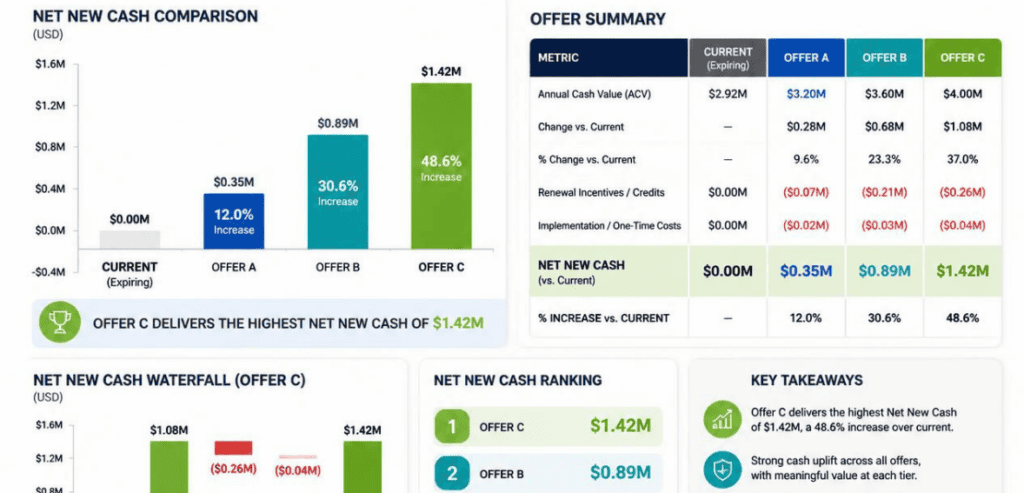
A merchant cash advance is not a loan. It is a sale of future receivables. You get a lump sum today. In return, the funder collects a fixed total from your future sales, set by a factor rate.
An MCA renewal offer occurs once you pay back a large portion of the original advance. Most funders extend offers after you reach 50% to 70% of the original advance payback. There is little complexity with this offer. The funder takes out a new advance, then uses a portion of that new advance to pay off the remaining balance of your original advance. The remaining balance of the new advance is sent to you as new capital to use.
The remaining new capital is what you should be most concerned with. It is the only money you gain through the deal. Everything new is just your old advance in new packaging.
Net New Cash Explained: The Only Number That Matters
Net new cash is the actual working capital you walk away with after the renewal retires your existing balance. It is the money you can spend on payroll, inventory, or growth. Nothing else in the offer puts a single dollar in your pocket.
Funders and brokers rarely lead with this figure. They lead with the gross advance amount, because a bigger number sounds better. A “$120,000 renewal” reads like $120,000 of opportunity. In reality, most of that sum may simply repay what you already owe.
How to Calculate Net New Cash
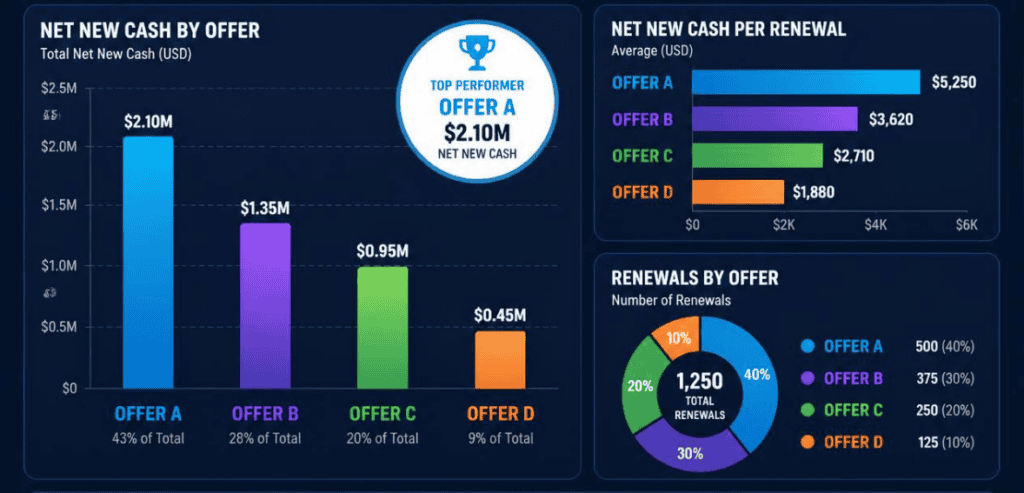
This simple formula applies when measuring the net cash impact of an advance. New cash equals new advance less the old balance payoff. Let’s say a funder approved a $120,000 advance and $60,000 cleared your old contract. In this case, net new cash would be $60,000. When evaluating the potential impact of costs, this amount would be the parameter.
When considering payoff amounts, always require the funder to confirm the payoff amount in writing. Be sure to confirm whether or not the payoff amount includes a buyout discount. A buyout discount forgives some of the unearned fees and thus reduces the payoff amount and increases net new cash. Failing to address a buyout discount results in you assuming the full liability for the old contract balance, and that is where the real problem in the new contract would emerge.
The Double Dip: Why the Factor Rate Can Mislead You
Here is the trap that snares thousands of business owners. The new factor rate applies to the entire new advance. That includes the portion used to pay off your old balance. So you get charged a fee on money you never receive, and you were already charged a fee on that same money in the first contract. Industry insiders call this the “double dip.”
Because of the double dip, your net new cash cost is higher than the stated factor rate. Let’s look at some real examples.
Suppose you took a $100,000 advance and had to pay back $140,000 at a 1.40 factor rate. Suppose you paid back $80,000 after 6 months. A broker offers to renew your advance for $120,000 at a 1.35 factor rate. This advance pays off your old balance of $60,000 and gives you $60,000 of net new cash. With the renewal, your total payback would be $162,000.
Now let’s look at the other option. Finish paying your old advance at a factor rate of 1.40. This would cost you $60,000. In the renewal, you would owe $162,000 to receive the $60,000 of net new cash. The cost of that $60,000 would be $102,000. For the broker’s renewal, the factor rate of 1.35 appears to be a discount, but in reality, the true cost of your cash increased significantly.
This is why, when you evaluate multiple MCA renewal offers, you need to evaluate by net new cash instead of factor rate on the sticker.
How to Compare MCA Renewal Offers by Net New Cash
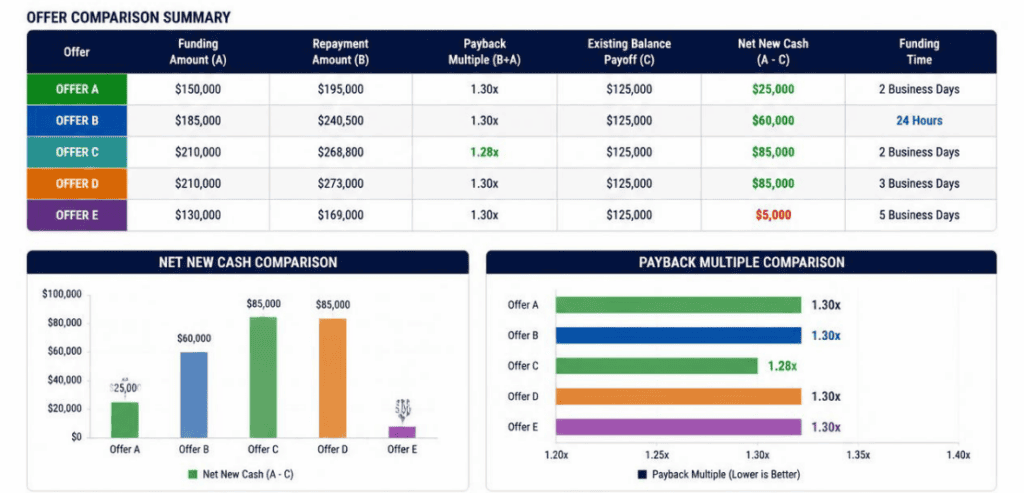
Four truthful inputs will help you compare two offers. First, you need to know the actual value of each offer, as well as any buyout discount that would reduce your debt. Now you know what each offer would pay you. Second, look at the net new cash that each offer would pay you. An offer that has a large advance but a large majority of that is payoff is not a good deal.
Third, to find the cost associated with each renewal, calculate the total payback, minus the balance you would owe anyway, minus the net new cash. This number is the cost of new capital. Divide that cost by the net new cash to find the cost percentage. Fourth, this cost value should be translated to an annual effective percentage rate using a realistic remittance period of time. A short remittance period creates a higher APR for the offer than what is shown.
When looking at multiple offers with multiple renewal options, the offer with a large advance usually is not the best. The best offer is the one that provides the most net new cash at the lowest cost. Using an online MCA calculator can reduce the time it takes to find the APR, but the most important thing is the discipline to compare all four numbers.
Questions to Ask Before You Sign a Renewal
A few pointed questions protect you at the table. Ask for the precise payoff amount and whether a buyout discount reduces it. Ask what your net new cash will be in dollars, not percentages. Ask how the new factor rate is applied and whether it touches the rolled-over balance. Ask whether an early payoff on the new advance earns a discount, because most MCAs charge the full fixed payback no matter how fast you repay. Finally, ask the broker how they are paid on the deal, since a full commission on a transaction that is mostly old debt tells you where their incentives point.
If a funder pressures you to sign the same day and refuses time for legal review, treat that as a warning, not a courtesy. Reputable providers give you room to read the contract.
The 2026 Regulatory Backdrop Works in Your Favor
The changes in the disclosure rules advantage borrowers in the marketplace. More states now require MCA providers to disclose the total cost, total repayment amount, and estimated APR prior to the borrower signing the contract. In 2026, California, New York, Utah, Virginia, Florida, Georgia, and Connecticut are on this list. Many other states have pending legislation.
The legislation gives you the right to demand that a personalized cost overview be provided with every offer. If a renewal disclosure does not clearly state the new cash amount and the APR of the cash amount, ask why.
New York Department of Financial Services
The New York Department of Financial Services has one of the strongest of these rules. Its Commercial Financing Disclosure Law has been in effect since August 2023 for transactions totaling up to $2.5 million. The law also outlines how the APR should be computed for sales-based financing as well as for financing in the context of a rollover or refinancing. Therefore, a New York renewal offer would be required to show you the true cost of the financing, not just a factor rate.
Yellowstone Capital
The January 2025 court order of the New York Attorney General against Yellowstone Capital for nearly $1.065 billion requires the company to cancel $534 million in merchant cash advances, which the New York Attorney General described as predatory loans disguised as merchant cash advances. This order also bans Yellowstone from operating in that industry. This case illustrates that predatory behavior coupled with renewal and stacking will lead to repercussions.
Alternatives Worth Pricing First
Prior to agreeing to refinance your MCA through any new deal, check competitor deals. Term loans or business lines of credit will most likely be cheaper if you can qualify. Nav is a good site to provide you with a comparison of working capital options in a simplified format. If you currently have multiple advances, consolidating these in a loan or even purchasing your advances in a negotiated buyout may be better than refinancing. Lower-cost SBA financing that many owners don’t consider is available through the SBA loan program, and you can access that financing option through the SBA loan portal. A renewal should be your last resort after looking into other financing options.
Conclusion
The gross advance amount on an MCA renewal offer is marketing. Net new cash is reality. Once you learn to strip out the rolled-over balance and price the double dip, the whole market looks different. The offer with the largest headline number is frequently the most expensive way to raise a modest amount of fresh capital.
So slow down when the “fresh start” call comes. Get the exact payoff. Calculate your net new cash. Price the incremental cost on that figure, convert it to an honest APR, and hold every competing offer to the same standard. Lean on the disclosures your state now requires. When you compare MCA renewal offers by net new cash, you stop paying twice for the same dollars, and you finally negotiate from a position of clarity.
Frequently Asked Questions
What does “net new cash” mean on an MCA renewal offer?
Net new cash is the actual working capital you receive after the renewal pays off your existing balance. It equals the new advance amount minus your current payoff. It is the only part of the offer that puts spendable money in your account.
Why is the effective cost higher than the factor rate on a renewal?
Because of the double dip. The new factor rate applies to the entire new advance, including the portion that simply repays your old balance. You pay a fee on money you never actually receive, and you already paid a fee on it once. That drives the true cost of your net new cash well above the stated factor rate.
Should I ask about a buyout discount before renewing?
Yes. A buyout discount forgives some of the unearned fees still built into your old balance. It lowers your payoff, which raises your net new cash and reduces your overall cost. Always ask whether the offer includes one and get the answer in writing.
Is a renewal ever a good idea?
Sometimes. If you urgently need capital, cannot qualify elsewhere, and the net new cash arrives at a defensible cost, a renewal can work. But price a term loan, a line of credit, or a consolidation first. A renewal should be a deliberate choice, not an automatic response to a broker’s call.